
What do you picture in your mind when you think of “brutalist architecture”? For most people, that’s something cold: a fortress of raw concrete, no windows at street level, a building designed to be looked at rather than walked through — structures built to make a statement, often at the pedestrian’s expense.
But not if you live in Vancouver.
When I first arrived here and started noticing the Vancouver brutalist buildings scattered across the city, something would feel off as I walked by them. Of course, the concrete is still there — raw, heavy, unapologetic. But it’s missing the hostility, the statement. They are almost… gentle. Vancouver’s version of brutalism broke those rules for me, and I rarely see people talking about it.
What Makes Brutalism “Brutalist” in the First Place
The Brutalism movement was born in the postwar decades as a reaction against ornament. The idea was structural honesty: raw materials, especially concrete, left exposed rather than dressed up, plumbing and electrical systems left visible rather than hidden — what I learned in architecture school as “the truth of the material,” where nothing is hiding. It was cheap, durable, and ideologically loaded: function over form, no decoration to distract from the building’s purpose.
In most places, brutalism leaned hard into that harshness. In Vancouver, for reasons rooted in geography, climate, and one architect’s particular obsessions, it became something else entirely.

The Architect Who Gave Vancouver’s Concrete an Accent
You can’t talk about Vancouver brutalist buildings without talking about Arthur Erickson. He designed or co-designed nearly every landmark example of the style in the city: Simon Fraser University, the MacMillan Bloedel Building, the Museum of Anthropology, the Law Courts at Robson Square, among others. But what makes his work so different from brutalist buildings elsewhere in the world wasn’t the building itself — it was what he insisted on putting around it.
“The strong landscape of the West Coast has ingrained its poetry into my sensibility and for better or worse conditioned my way of seeing. There was never a site, even the most unrewarding, which didn’t offer up some hidden pleasures to be enjoyed.”

Robson Square: The Building That Refused To Be a Monument
I believe Robson Square is the one project that defines my whole idea of how brutalism in Vancouver is gentler.
Erickson was commissioned to design a new provincial law courts and government complex in the early 1970s, at a moment when the original plan called for a 55-storey tower. According to his biographer, Erickson said, “This won’t be a corporate monument. Let’s turn it on its side and let people walk all over it.”

As a result, we now have Robson Square: a megastructure that assumes the profile of a stepped escarpment rather than a tower.
This isn’t a plaza you admire from the sidewalk. You get rows of elevated planters spilling over building façades, waterfalls tucked between terraces that drown out street noise, and stair-ramps connecting rooftop gardens down to street level. It builds a link between law at one end and art at the other, embracing government quietly in between.
Here, brutalism isn’t a monument to be photographed from across the street and admired through a phone screen. It’s furniture for the city.
But My Favorite Example Is…
There’s one specific brutalist building in Vancouver that has always caught my eye, and when I found out that this gentle, cozy, embracing building was the Law Courts, it kind of blew my mind.
Close your eyes and think of any courthouse you’ve ever seen. Like most government buildings, you’d probably picture something big, something that claims attention, that positions itself as more important than the buildings around it.
Not in Vancouver. Not with Erickson.

The Provincial Court of BC in Vancouver is the opposite of what you would picture when you think of a governmental brutalist building. Still, it is both.
Its low profile keeps it from dominating the skyline the way a verticle tower would. Its terraces sit in direct visual balance with the planting around them rather than above it. Its glass canopy brings transparency at street level. Its elevated pedestrian spine running over Robson Street creates real shade and shelter at sidewalk level, in a stretch dense with restaurants, where people actually sit and eat.
But None Of These Would Be Possible Without Her
The reason Erickson’s brutalism reads so differently from everyone else’s isn’t just that he always prioritized the pedestrian’s point of view — it’s also that he knew how to set his buildings into the city itself. And for that, he had the best possible collaborator: a landscape architect who worked side by side with him on multiple major projects, whose partnership is the real engine behind this whole regional style.
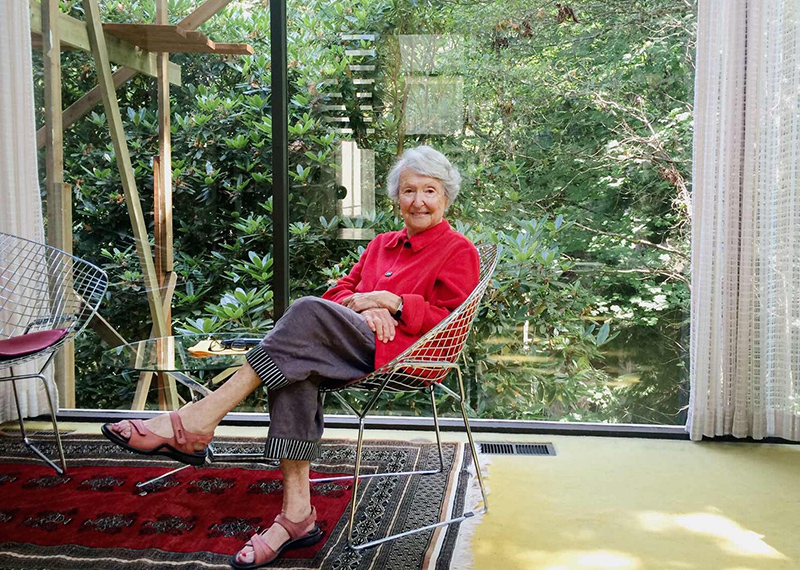
Cornelia Hahn Oberlander is the actual reason Erickson’s brutalist buildings don’t feel brutal, but gentle. At Robson Square, her planting plan of Japanese maples, pines, magnolia, and rhododendron, staggered across the terraces, gave Erickson’s concrete a lush, living counterweight — proof that simplicity and plainness aren’t the same thing.
Erickson once said, “Cornelia is the only person who understands what I’m talking about.” Given how much of this gentler, more pedestrian-friendly version of brutalism comes down to her work, it’s hard to disagree.
So, Is Vancouver’s Brutalism Actually “Gentler”?
Not uniformly — Simon Fraser University’s hilltop campus, for instance, is closer to the monumental, fortress-like brutalism found elsewhere, especially under grey winter skies. So this isn’t a claim that every brutalist building in the city is soft. It’s that Vancouver brutalist buildings developed a recognizable counter-tradition within the style: low instead of vertical, transparent instead of sealed, planted instead of bare, built in genuine partnership between architecture and landscape design rather than treating greenery as an afterthought.
It’s also worth saying plainly: a lot of this city’s lesser brutalist buildings have already been torn down, caught in that awkward window where a structure is too old to feel current but not yet old enough to be valued as heritage. The landmark, Erickson-and-Oberlander examples have mostly survived. The ordinary ones haven’t been so lucky — which is its own argument for paying closer attention to this style while it’s still standing.